There is now a small cement pieced bridge over the roadside ditch at the turn off to the land, and ditches have been dug for putting in the fence at the entrance to the property. The official NGO papers are in the hands of our acting board president, David Zokoe, in Bangui, and he is still following up on getting the land deed transaction established. The land papers must be in hand before we can actually begin work building and planting.
Wednesday, March 24, 2010
Monday, March 1, 2010
Bird's eye view of the CEFA land
The yellow border on the left is Cameroon. The brownish areas are grasses and brushland and old gardens, and the green indicates trees and heavier growth. The CEFA land has a mostly natural boundary of trees/jungle. The red lines are old off the beaten track roads, and the thicker light yellow lines between Gamboula and the mission station and beyond are the main roads. The road that Roy and his crews have been clearing is the lower red line that juts off the main road just north of the mission station where we currently live. You can see a gap in the tree line where the red lines meet together at the property boundary. That's where Roy is planning to put in a public orchard/park, to act as a buffer, so people can pick fruit freely without climbing the fence (that will be put in soon) and stealing what is not theirs.Saturday, February 27, 2010
The model farm
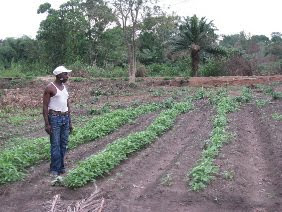
We have chosen a manager for the model farm that is being established down the road from the CEFA land. His name is Desiré, and boy does he have a green thumb. He has been growing and selling veggies for years, most recently here in our region. He will take care of the regular crops, such as peanuts, corn, and manioc (possibly new strains) as well as raising all sorts of vegetables. He will manage the fish ponds, which are under reconstruction right now. We are hoping to purchase a pair of oxen for pulling a plow, and there will be fruit trees on the farm as well. All this is in hopes of encouraging the locals to do the same, to provide a "do-able" example that anyone might follow in order to better feed and take care of their family.
Here is Desiré in the vegetable garden:
Here are the fish ponds being worked on:
The road is finished!
The road is completed, the road crews have been paid, and access to the CEFA land is now a straight shot without worrying about damaging your vehicle. The ditch for putting up the fence is being worked on, and the buffer zone of public orchard and park are mapped out along the whole front access of the land and now need to be cleared. The completion of the paperwork for the official NGO documents in the capital city is still in process. We have to jump through a few more hoops, it seems, but we have hopes that it will soon be done.
Wednesday, February 17, 2010
Progress with the CEFA land

The work on the road is going well. The five kilometer stretch of road from the main road to the CEFA property has almost been completed by groups of about 10 people each to clear 500 meter stretches. Hopefully it will be complete by the end of the week. Well, all except for the creation of ditches along the sides of the road to catch the runoff when the rains start. The ground is too hard right now in some places to make these rain gutters. The dry season is almost at an end, we usually have some rains beginning in mid-March.
Tuesday, February 9, 2010
It's a dog gone shame!
This story, from Roy, just landed in my inbox. While it may be a bit gruesome for the gastronomically unadventurous, it is the reality of life in our corner of the Central African Republic. In this account, Roy talks about his first taste of dog, an animal that most of us would not want to consume. Fortunately for me, dog is on the 'list' of foods taboo for women to eat in CAR. Whew!
-Angela
The other day, as we were working on the roads, I heard some of the crew mumbling that there was a dog in the stew pot out in the yard near where we were working. It was a large cooking pot and sure enough, when I went over to check it out, it was full of pieces of meat that were clearly from a dog (don't ask how I knew!). I asked the workers why people were cooking dog. They said that people are desperate for meat.
But, I said, this is the first I have heard of Central Africans eating dog. They replied that some do. I took a poll and it turned out that 4 out of 8 of the workers said they would eat it. One said it was the greasiest of all meats calling it "the meat that does not stick to your fingers". I challenged them and said, you know, in China, dog meat is a staple and they raise dogs just for consumption. Then, they dared me to try it!
Now, you have to understand, Central Africans eat just about anything that moves - I've had the pleasure of eating snails, grubs, caterpillars, monitor lizard, python, anteaters, and just about every type of mammal.... so, I am no wimp when it comes to trying new foods, ...... but dog? I could hardly say no, so, I went for it! It was pretty tasty and not tough at all! In the end, how is one mammal really all that different from another?
The point of this unusual tale is to point out that the search for a daily source of protein is becoming so difficult in Central Africa that people have resorted to eating their pets. At first, one may react to this as disgusting, but in reality, it is about survival. Put into the proper perspective, eating dog meat can increase the protein intake for your family, if only in the short term. While CEFA is open to new ideas for helping Central Africans with food security, raising herds of dogs is not one we will be advocating. CEFA will be focusing on more sustainable and low cost means to increase protein in the diet such as growing beans and raising fish.
-Angela
The other day, as we were working on the roads, I heard some of the crew mumbling that there was a dog in the stew pot out in the yard near where we were working. It was a large cooking pot and sure enough, when I went over to check it out, it was full of pieces of meat that were clearly from a dog (don't ask how I knew!). I asked the workers why people were cooking dog. They said that people are desperate for meat.
But, I said, this is the first I have heard of Central Africans eating dog. They replied that some do. I took a poll and it turned out that 4 out of 8 of the workers said they would eat it. One said it was the greasiest of all meats calling it "the meat that does not stick to your fingers". I challenged them and said, you know, in China, dog meat is a staple and they raise dogs just for consumption. Then, they dared me to try it!
Now, you have to understand, Central Africans eat just about anything that moves - I've had the pleasure of eating snails, grubs, caterpillars, monitor lizard, python, anteaters, and just about every type of mammal.... so, I am no wimp when it comes to trying new foods, ...... but dog? I could hardly say no, so, I went for it! It was pretty tasty and not tough at all! In the end, how is one mammal really all that different from another?
The point of this unusual tale is to point out that the search for a daily source of protein is becoming so difficult in Central Africa that people have resorted to eating their pets. At first, one may react to this as disgusting, but in reality, it is about survival. Put into the proper perspective, eating dog meat can increase the protein intake for your family, if only in the short term. While CEFA is open to new ideas for helping Central Africans with food security, raising herds of dogs is not one we will be advocating. CEFA will be focusing on more sustainable and low cost means to increase protein in the diet such as growing beans and raising fish.
Wednesday, January 27, 2010
The BBC Shows Why the Work of CEFA is Vital
This morning I saw a stunningly depressing array of pictures from the
area around Gamboula, in South-west Central African Republic. But I
also have hope for the people in the pictures knowing that CEFA's goal
is to teach women, such as those pictured in the BBC's photo montage,
to grow more than cassava for their families to eat. Click on the BBC
link to see more.
http://news.bbc.co.uk/2/hi/africa/8476107.stm
area around Gamboula, in South-west Central African Republic. But I
also have hope for the people in the pictures knowing that CEFA's goal
is to teach women, such as those pictured in the BBC's photo montage,
to grow more than cassava for their families to eat. Click on the BBC
link to see more.
http://news.bbc.co.uk/2/hi/africa/8476107.stm
Subscribe to:
Posts (Atom)